RDC : Joseph Kabila souhaite le renforcement de la présence de la Monusco à Beni

Admin's avatarCongolese Action Youth Platform

MeetingKabila07

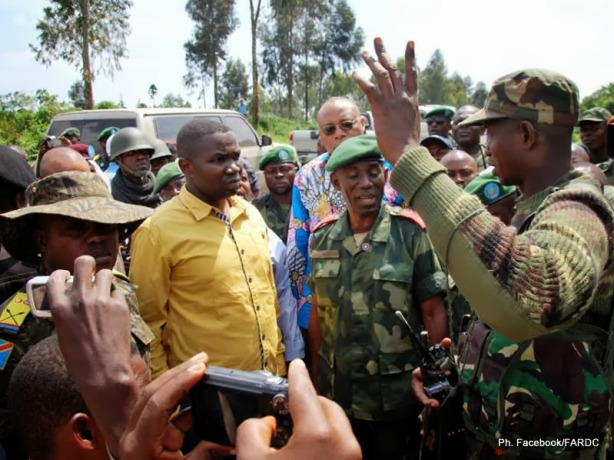
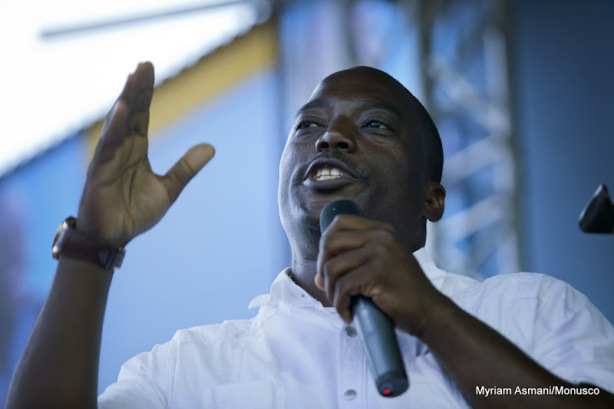
Dans son adresse vendredi 31 octobre à la population de Beni au Nord-Kivu, le président de la RDC, Joseph Kabila, souhaite voir la Monusco renforcer sa présence dans cette zone pour faire face aux problèmes d’insécurité. Arrivé dans cette ville depuis trois jours, le chef de l’Etat a également mis en garde les rebelles ougandais de l’ADF accusés d’avoir tué environ quatre-vingts personnes en un mois.

View original post 508 more words

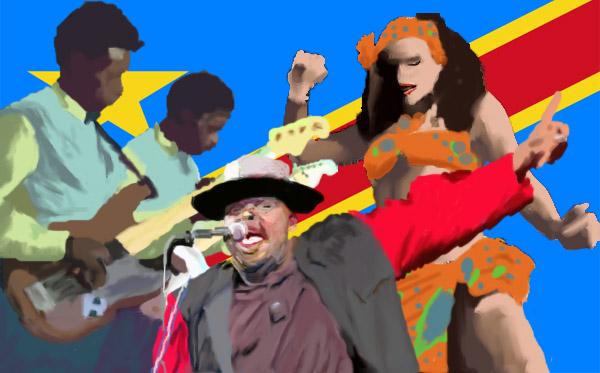
Towards the Forbidden City: Super Guitar Soukous

Sprayon Pants's avatarWasherman's Dog

soukous

Strike while the iron is hot. Make hay while the sun shines. Post while you can for in Beijing all this stuff is banned.

Yes for the next week or so I will in the Forbidden City which is not named that for no good reason. Last time I was there nearly every website I’d made friends with over the years was unavailable. Certainly no Facebook, YouTube, WordPress, Blogspot

I will be otherwise preoccupied of course with official business, side meetings, drafting committees and the like, so it is probably a good thing that I will not be detracted.

So before I take that long flight I thought you all might like to groove to some wonderful bubbly soukous. An old favorite, this is a collection I picked in the deserted steet stalls in Bali about 3 days after the terrible 2002 bombings that left so many dead as they…

View original post 215 more words

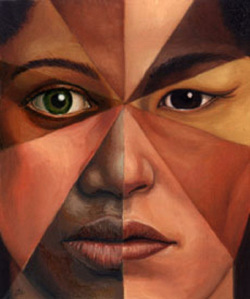
Getting over the inherited racist tendencies of my generation.

Roos Demol's avatarMigrants in Ireland

mixed race IrishOne of the lessons I have learned over the last few years as an expat, and through my friendships with people from all over the world is that racism is much more prevalent than we think.

I think that any white person of my generation is racist by nature or rather by inheritance. It is up to ourselves to do something about it.

There are many forms of racism, but I am talking of the most obvious one, the racism by white people against black Africans.

The first time I saw a black person, was when I was around 5 or 6. I was playing in the park with my sisters, sitting on the green grass in the sun and making daisy chains . A black woman watched us and I remember she was crying and came to ask if she could take a photograph. We said yes, of course…

View original post 1,149 more words

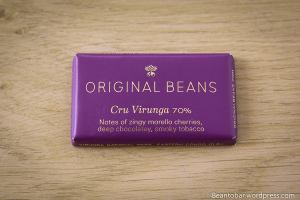
Review: Original Beans – Cru Virunga 70% (****)

congolese chocolate

Kris Kellens's avatarbean-to-bar

sometimes chocolate makers make things simple… a little rectangular piece I received as a present from my wife, made me smile even before I tried it.

My local “haute chocolat” shop – Hilde Devolder Chocolatier only offers the small pieces, but they are more than enough to create a review.

Original Beans still puts high efforts in creating quality origin chocolate, while helping the conservation of the rainforest cacao is indigenous to.
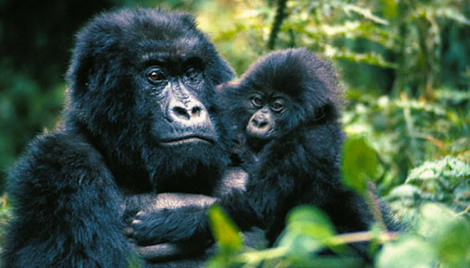
Every sold bar equals a new cacao tree planted in one of the plantations they cooperate with. In the case of Cru Virunga, they take us to the very heart of dark Africa: Congo. And while you enjoy a nice piece of chocolate and help save natural habitats, you even help protecting the endangered Mountain Gorilla! Original Beans offers so much more than simply chocolate.

KKBTB20141006-1

Every origin Original Beans create has its own distinct color scheme. The Cru…

View original post 306 more words

Affaire Mamadou Ndala : les juges sont arrivés à Beni

Admin's avatarCongolese Action Youth Platform

mamadou et paluku

Les juges de la cour militaire opérationnelle du Nord-Kivu qui siègera en chambre foraine dans l’affaire Mamadou Ndala sont arrivés à Beni lundi 29 septembre. Le président de cette cour a annoncé une dizaine d’audiences pour faire éclater la vérité sur l’assassinat de l’ancien commandant du 42e bataillon commando des unités de réaction rapide de l’armée congolaise survenu le 2 janvier dernier.

View original post 192 more words

Unesco’s World Heritage Sites of Congo

The Golden Scope's avatar

Gorillas in Congo

Written by Valentina Romano

The Democratic Republic of the Congo—also known as DRC or Congo—is a country located in Central Africa. Most people are not aware that the Democratic Republic of the Congo is not the same as the Republic of Congo, which is a nation located on the northern borders of the DRC.

Salonga 6

Congo borders the Central African Republic, South Sudan, Uganda, Rwanda, Burundi, Tanzania, Zambia, Angola, the Atlantic Ocean, and, as mentioned before, the Republic of Congo.
aactivity-83-1

You are probably wondering how a country could border 9 states and one ocean! Well the DRC can, as it is the second largest country in Africa by area, and the eleventh largest in the world.
a tagbonobos26n-3-web

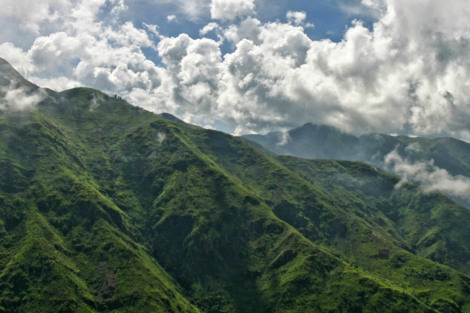
The UNESCO selected five natural sites located in the DRC, to protect an safeguard under the World Heritage Sites’ List: Garamba National Park (under UNESCO since 1980), Kahuzi-Biega National Park (1980), Okapi Wildlife Reserve (1996),

View original post 394 more words

Artist of the Month: October with Richard Mosse

curatingthecontemporary's avatarCuratingtheContemporary (CtC)

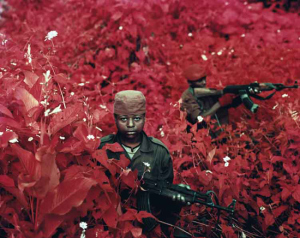
R. Mosse, Vintage Violence, 2011 R. Mosse, Vintage Violence, 2011

CtC’s Artist of the Month for October is this year’s winner of the prestigious Deutsche Boerse Prize. Richard Mosse (b. 1980) is an Irish conceptual documentary photographer currently based in the US. His project, The Enclave, is the final result of his work in the eastern Democratic Republic of Congo.

For its continuous wars, Congo is perceived in the western world as a place of darkness. By using an obsolete infrared film, once employed to reveal camouflaged stations, Mosse represents it instead as a surreal world of colours and light. At the same time though, his hallucinated view intends to underline the insufficiency of the photographic means in representing Congo’s disillusioned and overly troubled situation.

For the 55th Venice Biennale, in which Richard Mosse represented Ireland, The Enclave was turned into an immersive video installation shot on discontinued military surveillance film and accompanied by…

View original post 97 more words

A Tasty Congolese Relish with Manioc Leaves – Isombe y’umwamba

dianabuja's avatarDIANABUJA'S BLOG: Africa, The Middle East, Agriculture, History and Culture

Cooking palm nuts to soften the nuts for oil e...

The following recipe – ‘Manioc leaves with crushed palm oil kernels‘ – is popular throughout central Africa and combines three of the most important local ingredients – manioc leaves, fresh oil from palm nuts, and ground nuts.

Here are the ingredients – quantities are pretty much up to you:

Fresh manioc leaves –
Oil palm nuts –
Fresh peanuts –
Leeks
Garlic –
Palm oil
Red pepper –
Salt –
 

Preparation requires a bit of work. First, you must collect a basket of tender manioc leaves:

Then, you need to pound the manioc leaves into a paste, like this:

In the meantime, send your menfolk off to collect a bunchor two of fresh palm nuts:

You prepare the oil palm nuts by removing the flesh from the kernels and pounding it – then, you squeeze the crushed fibers between your hands, using the liquid, but…

View original post 240 more words

Rural Markets in the Congo, 1871

dianabuja's avatarDIANABUJA'S BLOG: Africa, The Middle East, Agriculture, History and Culture

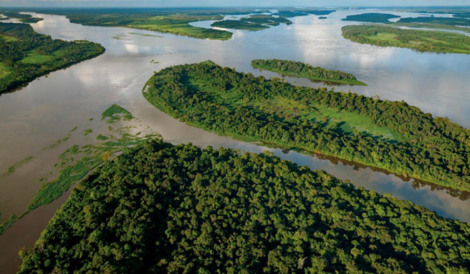
In many parts of Africa, rural markets are the most important method for buying and selling agricultural goods. The following description of a large rural market near the Lualaba River in N.E. Congo by David Livingstone could be a description of many rural markets today. With a few exceptions, the items being sold are the same.

1st April, 1871._–The banks are well peopled, but one must see the gathering at the market, of about 3000, chiefly women, to judge of their numbers. They hold market one day, and then omit attendance here for three days, going to other markets at other points in the intervals. It is a great institution in Manyuema: numbers seem to inspire confidence, and they enforce justice for each other. As a rule, all prefer to buy and sell in the market, to doing business anywhere else; if one says, “Come, sell me that fowl or…

View original post 770 more words

Cuisine and Crops in the Congo Delta, 1863

dianabuja's avatarDIANABUJA'S BLOG: Africa, The Middle East, Agriculture, History and Culture

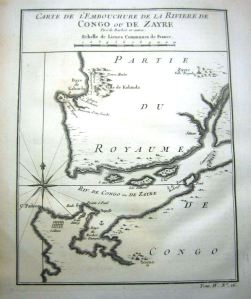
The crops and cuisine of groups living in the delta area of the Congo river in the mid 19th Century is interesting in that there apparently was little processing of crops, other than cassava.  Of course, Sir Richard Burton‘s data comes only from the season he was there, and he gives  no information on processing fresh crops for post-harvest use.

 Meat rarely appears; river fish, fresh or sun-dried, is the  usual “kitchen,” eaten with manioc, toasted maize, and  peeled, roasted, and scraped plantain: vegetables and  palm-oil obtained by squeezing the nut in the hands, are the  staple dish, and beans are looked upon rather as slaves’  food. They have no rice and no form of ‘daily bread’…

 …The greens, cabbages, spinach, and French beans,  mentioned by Tuckey*, have been allowed to die out. Tea,  coffee, sugar, and all such exotics, are unappreciated, if not  unknown; chillies, which…

View original post 152 more words